
Art field guide
Game art reference sites and production breakdowns
Study shipped game art through visual archives and production breakdowns. Specialist forums, recorded talks, and game jams offer practical ways to learn technical art and finish work.
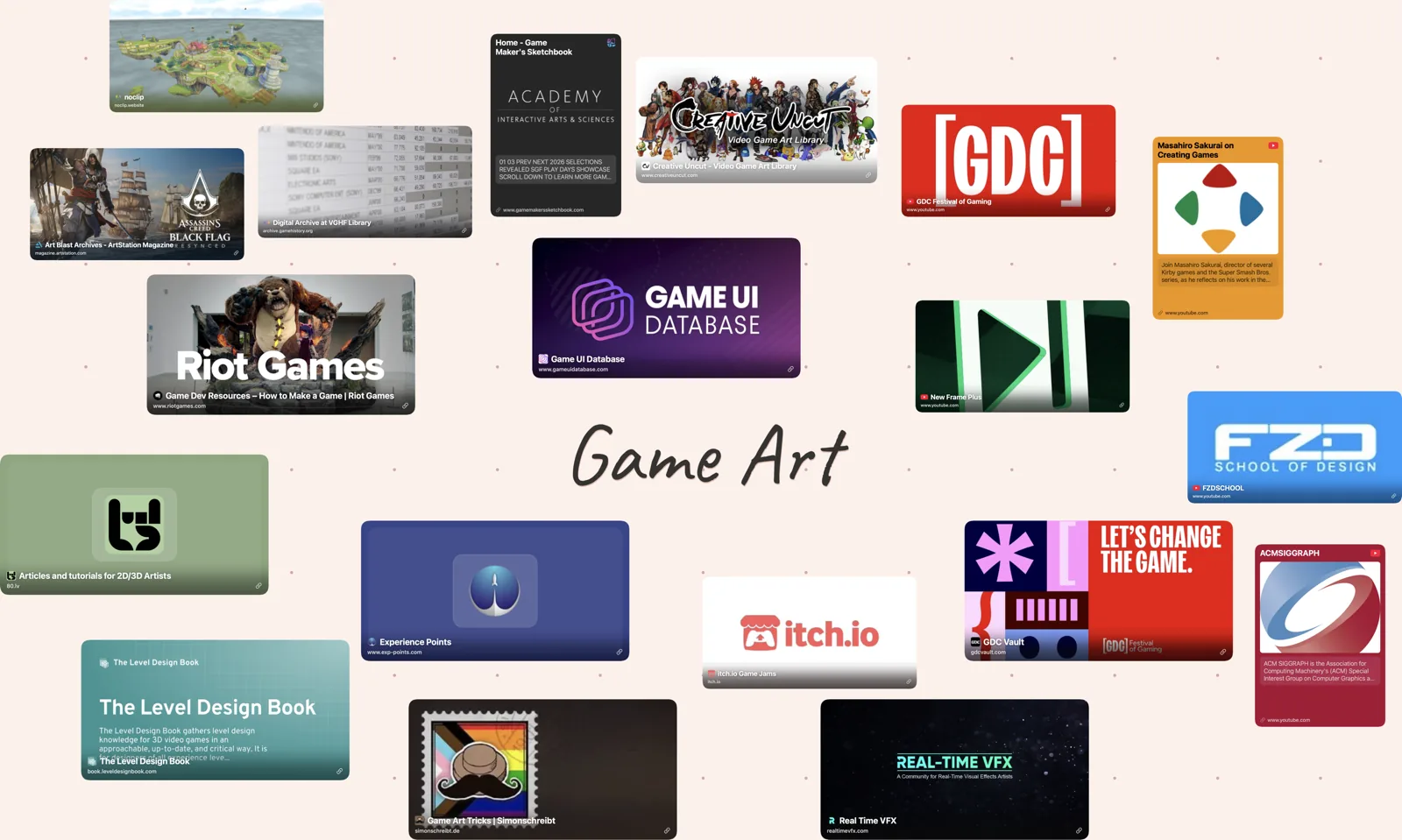
The .artdeck file opens in ArtDeck for iPhone, iPad,
and Mac with its link cards, previews, and layout intact.
New to ArtDeck?
Get it free for 7 days, opens in a new tab,
then open the downloaded file from Files
on iPhone and iPad, or double-click it on Mac.
Start here
Open these four first.
If you have ten minutes, these do the most work. The full list follows.
- Creative Uncut, opens in a new tab
Official artwork organized by title, the widest visual archive on the board.
- Game Art Tricks, opens in a new tab
The clearest explanations of why shipped games look the way they do.
- GDC YouTube, opens in a new tab
Free recordings of the talks behind the visual decisions.
- noclip, opens in a new tab
Walk through extracted levels to study composition and lighting from any angle.
Public resource list
Every link in the board.
Open any source without leaving the list. External links open in a new tab, and each entry says whether it costs money or needs an account.
Visual reference and archives
- Creative Uncut , opens in a new tab
ArchiveFreeNo account
A large browsable library of official game artwork organized by title.
creativeuncut.com Permalink Report a change
- Game Maker's Sketchbook , opens in a new tab
ArchiveFreeNo account
An annual showcase of sketches and production artwork from game makers.
gamemakerssketchbook.com Permalink Report a change
- ArtStation Magazine: Art Blast Archive , opens in a new tab
Studio featuresFreeNo account
Studio-published collections showing the artists and artwork behind shipped games.
magazine.artstation.com Permalink Report a change
- noclip , opens in a new tab
3D level viewerFreeNo account
A navigable museum of extracted game levels for studying environments, lighting, composition, and spatial design.
noclip.website Permalink Report a change
- Video Game History Foundation Digital Archive , opens in a new tab
ArchiveFreeNo account
Digitized magazines, development material, press collections, recordings, and other primary sources.
archive.gamehistory.org Permalink Report a change
- Game UI Database , opens in a new tab
ArchiveFreeNo account
A searchable collection of game-interface screenshots, with filters for screen type, genre, and visual style.
gameuidatabase.com Permalink Report a change
Production and technical art
- Riot Games: Game Dev Resources , opens in a new tab
LessonsFreeNo account
Lessons from Riot developers on game art, animation, UI, and VFX.
riotgames.com Permalink Report a change
- Experience Points , opens in a new tab
ArticlesFreeNo account
Environment-art breakdowns and interviews with practicing artists.
exp-points.com Permalink Report a change
- 80 Level: Articles and Tutorials , opens in a new tab
ArticlesFreeNo account
Artist interviews and workflow breakdowns across 2D, 3D, and real-time production.
80.lv Permalink Report a change
- GDC Vault: Visual Arts , opens in a new tab
TalksFree tierAccount optional
Conference sessions focused on visual arts, pipelines, production decisions, and shipped-game case studies.
gdcvault.com Permalink Report a change
- Game Art Tricks , opens in a new tab
ArticlesFreeNo account
Detailed investigations into rendering tricks and visual techniques used in games.
simonschreibt.de Permalink Report a change
- The Level Design Book , opens in a new tab
BookFreeNo account
A free, engine-agnostic book about building, testing, and communicating 3D level design.
book.leveldesignbook.com Permalink Report a change
- Real Time VFX , opens in a new tab
ForumFreeAccount optional
A specialist forum for critiques, breakdowns, and technical questions about real-time effects.
realtimevfx.com Permalink Report a change
Video libraries
- GDC YouTube , opens in a new tab
VideoFreeNo account
Free GDC recordings, including sessions on art, animation, design, and production.
youtube.com Permalink Report a change
- Masahiro Sakurai on Creating Games , opens in a new tab
VideoFreeNo account
Clear, concise lessons on game production and design from the director of Kirby and Super Smash Bros.
youtube.com Permalink Report a change
- FZDSCHOOL , opens in a new tab
VideoFreeNo account
Long-form concept-design demonstrations and industry guidance for games and film.
youtube.com Permalink Report a change
- New Frame Plus , opens in a new tab
VideoFreeNo account
Professional analysis of video-game animation, with close readings of movement, acting, and combat.
youtube.com Permalink Report a change
- ACM SIGGRAPH Videos , opens in a new tab
VideoFreeNo account
Conference recordings on computer graphics research, rendering, and digital art.
youtube.com Permalink Report a change
Practice through making
- itch.io Game Jams , opens in a new tab
DirectoryFreeAccount optional
A directory of game jams for practicing scope, art direction, collaboration, and finishing work.
itch.io Permalink Report a change
Suggested practice path
One session with this board.
Follow the steps in order, or take the one that fits today.
Choose one shipped game and collect its official art from Creative Uncut and an Art Blast feature side by side.
Walk the same game in noclip and screenshot three views that explain its composition and lighting.
Read one Game Art Tricks or Experience Points breakdown and note the single technique you want to copy.
Watch one GDC or Sakurai session on that technique, then rebuild it in your own tool.
Finish a small piece in an itch.io jam to test the technique under a deadline.
Use the arranged version
Take the whole collection into ArtDeck.
Rearrange the cards and add your own references. Keep the board open next to the app where you work.
 opens in a new tab
 Free for 7 days, then one purchase. No card. No subscription.
Suggest a source