

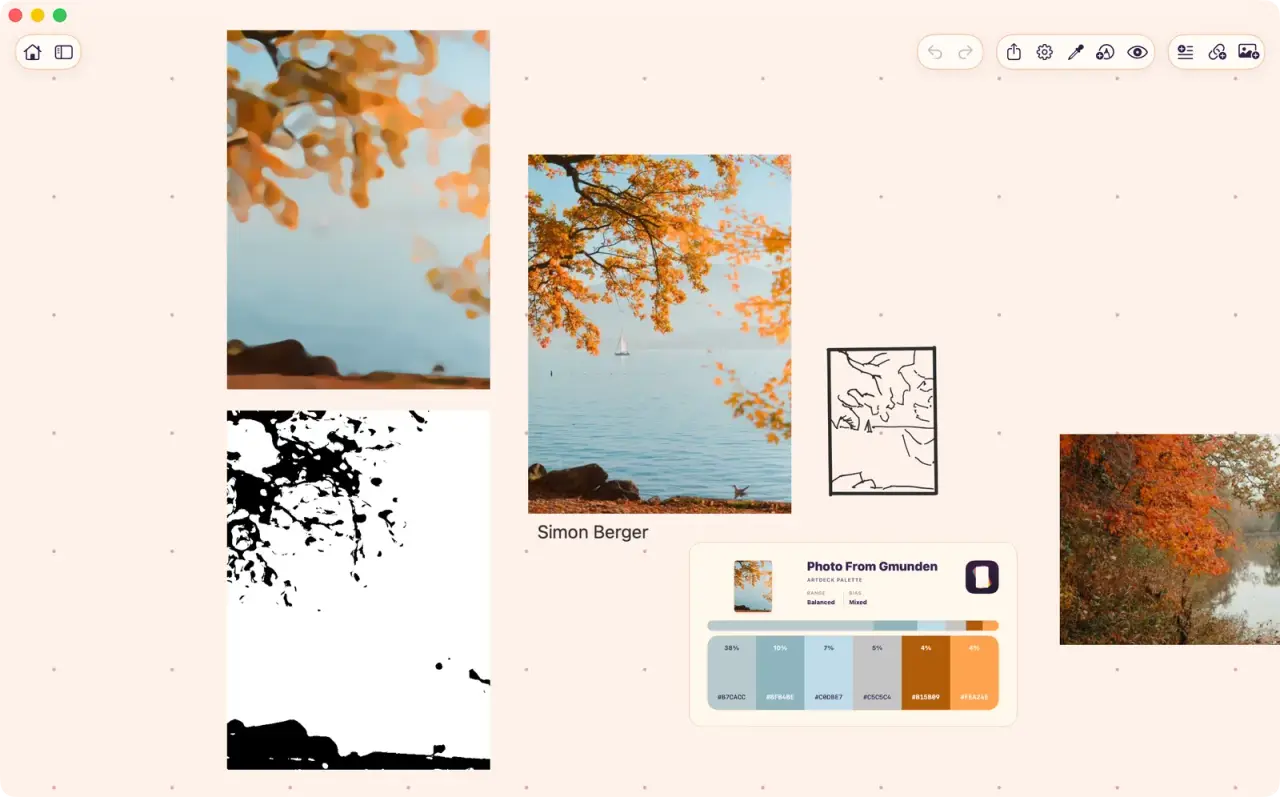
Thirty minutes is enough for one question. I spend most of it drawing by eye and bring out the tools only after I have committed to an answer. For the last five minutes, I hide the source and draw the relationship again from memory or on a different subject. That sketch is often ugly and useful: it shows what stayed with me once the picture was gone.
Polish makes a weak study hard to diagnose. When the proportions drift but the value grouping works, the finished copy no longer shows which judgment improved. A narrow question makes the session readable, even when the answer is, “I misread it.”
Choose one question
Choose the image that makes one problem unusually easy to see. Strong lighting separates value groups; a limited palette exposes the balance between a quiet field and a small accent. For proportion, I want a pose whose long axes still read at thumbnail size.
Before drawing, I add a note to the board with the question. It might be:
- Which three value groups make the light read?
- How much of the frame does the warm accent occupy?
- Which large shapes lead to the focal point?
- Where do the hardest edges sit?
- How long is the torso compared with the head?
Once the question is there, everything else is allowed to be messy: let the contour wobble in a value study, leave the shading unfinished in a proportion study. The same reference can wait for another session, and it is often better when it does.
Make a small study without aids
Dorian Iten’s value-study assignment at Proko gives each attempt 15 to 30 minutes. That pressure is useful because it forces tonal relationships to come before detail. Try the same constraint here: keep the reference visible, close the analysis tools, and work small enough that finishing is inevitable.
For a value thumbnail, three to five flat tones are plenty. Put down the broad light and dark groups, then ask whether the image needs one middle value or several. If three tones explain it, stop at three. A color study works much the same way: choose a handful of swatches and estimate their share of the frame before painting a block-in.
A composition study may fit inside a frame with four or five shapes. With a figure or object, I choose a unit of comparison, perhaps the head or the width of the ribcage, and build the subject from simple forms. This asks more of me than tracing a contour because I have to account for depth.
Stop as soon as you can answer the question you set out to study. Save the polish for another drawing.
Check the attempt with the source
Resist the urge to repair the first attempt, even when the miss looks obvious in hindsight. Put the check next to the drawing so the original judgment stays visible.
Value
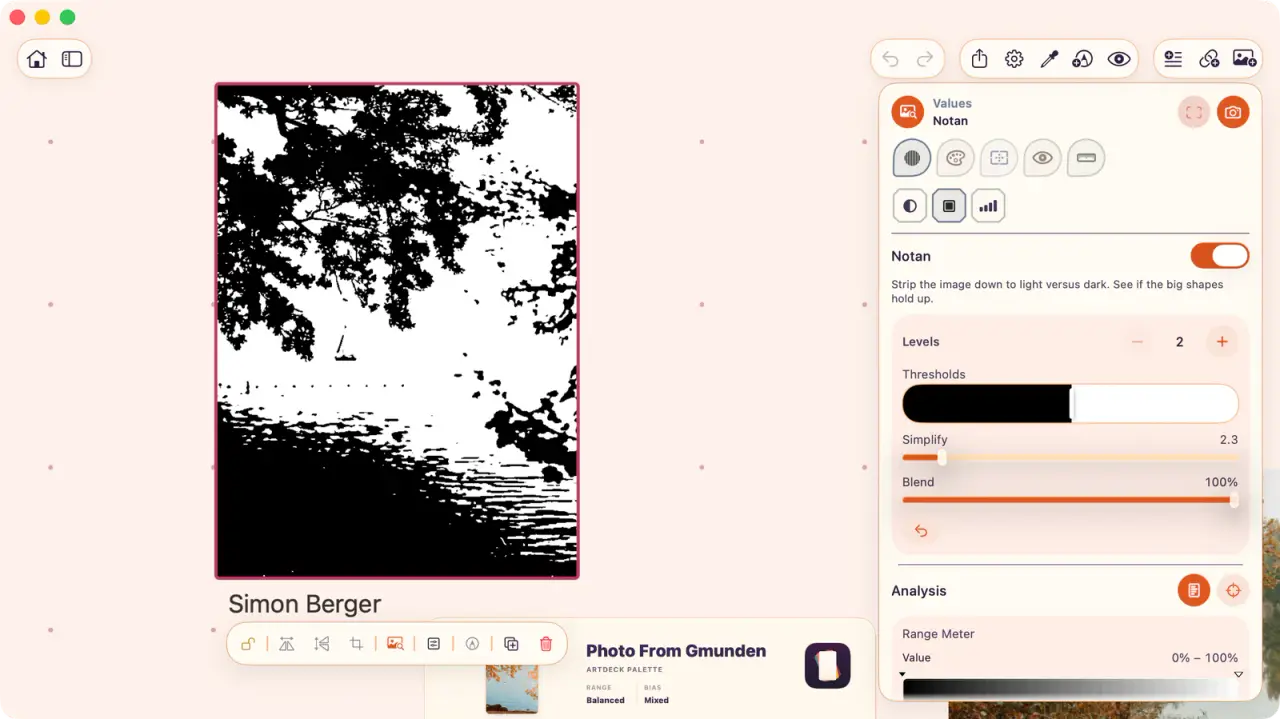
Convert the source to grayscale and compare the largest masses before looking at small patches. A two-value Notan makes the disagreement blunt: shapes either join or they do not. As you move the threshold, watch for a dark you split apart even though the source holds it as one shape.
I check range with the grayscale view and grouping with the Notan. They expose different mistakes, and naming the right one matters when you decide what to practice next.
Color
Put your guessed swatches on the board before extracting a palette, otherwise the tool answers the interesting question for you. Compare value and temperature first. Exact hue can wait until you know how much room each color occupies.
In the lake reference above, the two oranges each cover four percent of the image while pale blue-grey covers 38 percent. A study built around “autumn orange” can easily give the accent too much room. Write the corrected relationship as an instruction you could use again: “a cool field with two small warm accents” is more useful than a row of hex values.
Composition and edges
Set the shape map next to the source and pay attention to the crop and the quiet areas; they often reveal more than a compositional grid. I save the grid for an alignment that has escaped me rather than treating it as a stamp of approval.
Then squint at the source, or add enough blur that the small detail disappears. Which edges remain firm? Where does one shape dissolve into its neighbor? If the study has the same edge around everything, choose one focal edge and let several others go quiet.
Proportion
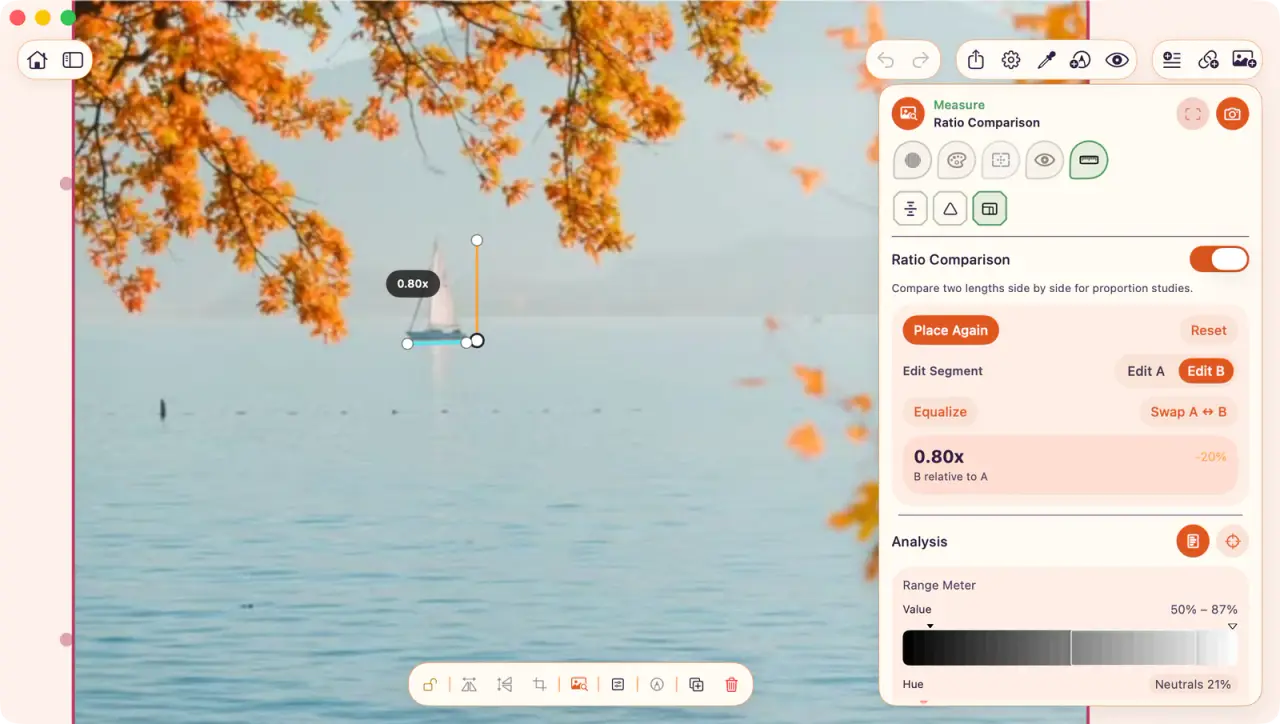
Choose one length as the unit and commit to an estimate: “the forearm is about three quarters of the upper arm.” Only measure after writing it down. The ratio shows how your estimate drifted: 0.75 on paper, 0.62 in the source.
Treat the measurement as a lead for the next attempt. Add two notes to the board with the untouched study: one judgment that held up and the largest miss. That is enough direction for another drawing.
Close the reference and draw it again
Now hide the image properly, without leaving a little thumbnail peeking from the corner. Give yourself five minutes to rebuild the study from memory and forget about finish.
When the source comes back, compare the large decisions first. If the main value division or proportion vanished, look at that passage once more and try again. Proko’s visual-memory exercises use this same observe, hide, draw, and check cycle; harder versions turn the subject or alter its proportions.
Memory is ruthless about throwing detail away. It tends to keep what you understood or found distinctive; the missing pieces show where your hand followed the image without building a clear model of it. That can sting, and it gives the next attempt somewhere specific to go.
Use the lesson in a different image
Use the idea with a different subject. Carry over the decision you studied rather than the arrangement of the original image.
Maybe a new landscape reuses the same three-value relationship, or a costume borrows the ratio between a warm accent and its neutral field. A figure can keep the gesture while changing the body type. The one sharp transition from an edge study can move to a completely different focal point.
Let this drawing be crude. If the idea falls apart as soon as the subject changes, return to the study and describe the relationship with more care.
Keep the first attempt
Keep a small trail of evidence: the reference, the first attempt, the check, and the memory or transfer drawing. Saving only the corrected version erases the judgment that needed work.
After several sessions, familiar misses begin to show themselves. My compressed darks might call for a week of value thumbnails; drifting long axes might call for more estimates followed by ratio checks. Your next exercise can come from that pattern instead of a generic practice list written for everyone and no one.
Then make something you care about, carry one relationship from the study into it, and let the rest go. Keep the awkward first attempt. A month from now it may be the clearest proof that your eye has changed.
The study tools page covers every lens, and the reference board page shows how a project board is built. If the reference moves, the frame-by-frame workflow finds the decisive frame.
Common questions
How long should one study take?
Thirty minutes is enough for one question, and the pressure is the point: Dorian Iten’s value-study assignment at Proko gives each attempt 15 to 30 minutes, which forces tonal relationships to come first. Stop as soon as you can answer the question you wrote next to the study. Polish makes a weak study hard to diagnose, because a finished copy no longer shows which judgment failed.
Is this just tracing or copying with extra steps?
The opposite, and the order is what prevents it. You draw by eye first and commit to an answer, then bring out a tool to check the specific thing you guessed at. Extracting a palette before writing down your own guess lets the tool answer the interesting question for you, which is how a study turns into a smaller copy.
Do I need to be good at drawing to get something out of this?
No, and the checks are useful precisely when your eye is still forming. Reducing a photograph to two values or reading a palette’s proportions tells you something true about the image whether or not you draw it well afterwards. Plenty of people run a lens over a picture simply because they want to know why it works.
Why keep the first attempt if it is wrong?
Because the corrected version erases the judgment that needed work. Keeping the reference, the first attempt, the check, and the redraw together means that after several sessions the familiar misses show themselves: compressed darks that call for a week of value thumbnails, or drifting long axes that call for more estimates and ratio checks.