

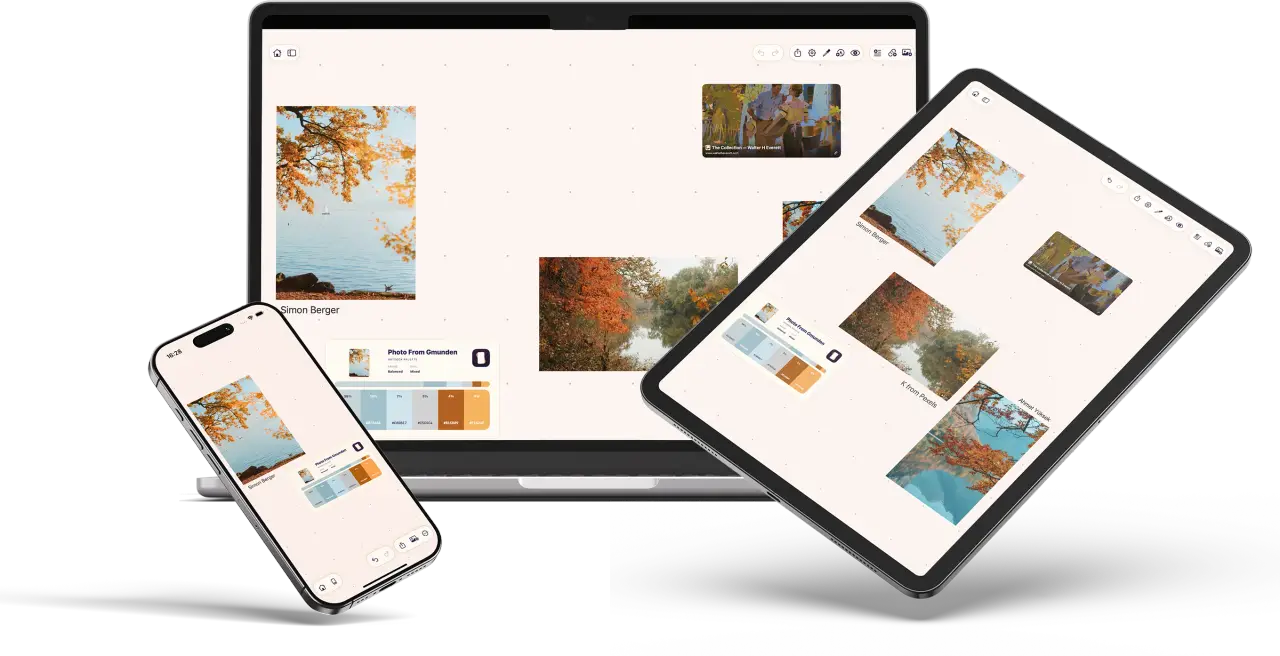
The short decision
If the board has to open on an iPad, ArtDeck is the answer. If everything stays on one desktop, PureRef’s window modes and its Windows and Linux builds keep it in the running.
Most of the daily surface is shared, so the habits move with you: drag and drop, crop and flip, grayscale preview, color picking, notes, drawings, groups, align and pack, locking, stacking order, GIF playback with frame stepping, and keyboard control.
| Decision | ArtDeck | PureRef 2.1 |
|---|---|---|
| Platforms | iPhone, iPad, and Mac, on iOS 18, iPadOS 18, or macOS 15 and later. | Windows 10+, macOS 10.14+, and Linux. No iPhone or iPad version. |
| License | Free for 7 days, then one App Store purchase at one price, with no commercial tier and no subscription. | Choose the amount for personal use. Commercial work costs $49 once for up to three users, then $8 per seat per month billed annually or $10 billed monthly. |
| Beyond images | Video, PDFs, link cards with previews, and saved studies on the same board. | Images and animated GIFs. Video files are not among its supported formats. |
| Video reference | Yes. Playback speed, frame stepping, frame export, and onion skinning. | No. Its motion controls apply to animated GIFs only. |
| Study tools | Yes. Values and Notan, color and palettes, composition, readability, measurement, and motion study with onion skinning. Save studies on the board. | No. Grayscale, color picking, and GIF frame controls, but no analysis suite or onion skinning. |
| Board file | Optional per-board iCloud sync, plus a restorable .artdeck export. No .pur import; an existing board comes across as exported images. | A local .pur scene file, with image data embedded by default or linked to local files. |
| Click-through window | No. Keep on Top does not pass clicks to the app beneath it. | Yes. Transparent To Mouse passes clicks to the underlying app. |
| Desktop window | Keep on Top on Mac. | Always on top, always on top of one chosen app, click-through, and a mode that gives each image its own floating window. |
ArtDeck covers iPhone, iPad, and Mac
Collecting happens wherever you are. Across a week you save a dozen images, some from Safari on the Mac, some from a message or a photo on the phone. On Saturday the board is already open on the iPad next to the drawing app, and it is there again on the Mac when the piece moves to final. PureRef stays on the desktop, with no iPhone or iPad version, so its board never reaches the iPad.
ArtDeck stops at iPhone, iPad, and Mac, and needs iOS 18, iPadOS 18, or macOS 15. A workflow that has to reach Windows or Linux belongs in PureRef, and so does an older Mac: the PureRef Mac build still supports macOS 10.14.
Boards work offline, sync runs on your own iCloud with every board carried across or chosen ones left on one device, and there is no ArtDeck account to create. On iPad, Split View and Stage Manager keep the board in its own pane next to whatever you are drawing in. The reference board page shows how one is built.
Moving a PureRef board across
ArtDeck does not read .pur files, so a board comes across as its images, and PureRef has an export for that.
File > Export > All images (⌥⌘I on Mac, Ctrl+Alt+I on Windows) writes every image on the scene to a folder you choose, in jpg, png, bmp, or the original format, cropped or uncropped depending on one checkbox. Selected images does the same for a subset. Drop that folder onto an ArtDeck board and the references are on the canvas. On an iPad, put the folder in Files or iCloud Drive first, then drag from there.
The arrangement does not come across. Tidy packs the selection, and snapping, align, and distribute square up whatever you want deliberate, so the board reads properly again in a few gestures. The import is also a good moment to leave behind the images you stopped using. If one specific layout is itself the work, keep that scene open in PureRef and start ArtDeck with the boards that have to be on the tablet.
PureRef has more specialized desktop window modes
PureRef’s window can stay above every app, or above one chosen app, so it floats over your painting program and stays out of the way everywhere else. It can pass mouse clicks straight through to whatever sits underneath, so a reference sheet can hang over the canvas without intercepting a brushstroke. Overlay mode gives each image its own small window, so a handful of references can sit around the edges of the screen instead of inside one board. Its shortcuts can be rebound, and ArtDeck’s are fixed.
ArtDeck’s Keep on Top keeps the board above other windows on Mac, with no click-through and no separate overlays. A transparent workspace on Mac is a roadmap candidate, not something you can use today. If click-through or per-image overlays are part of how you paint on a desktop, keep PureRef for that job.
None of those modes exist on an iPad, in either app. The equivalent is Split View or Stage Manager, where the board holds its own pane next to the drawing app, and that part ArtDeck does on the device where PureRef does not run at all.
Motion and image study differ most
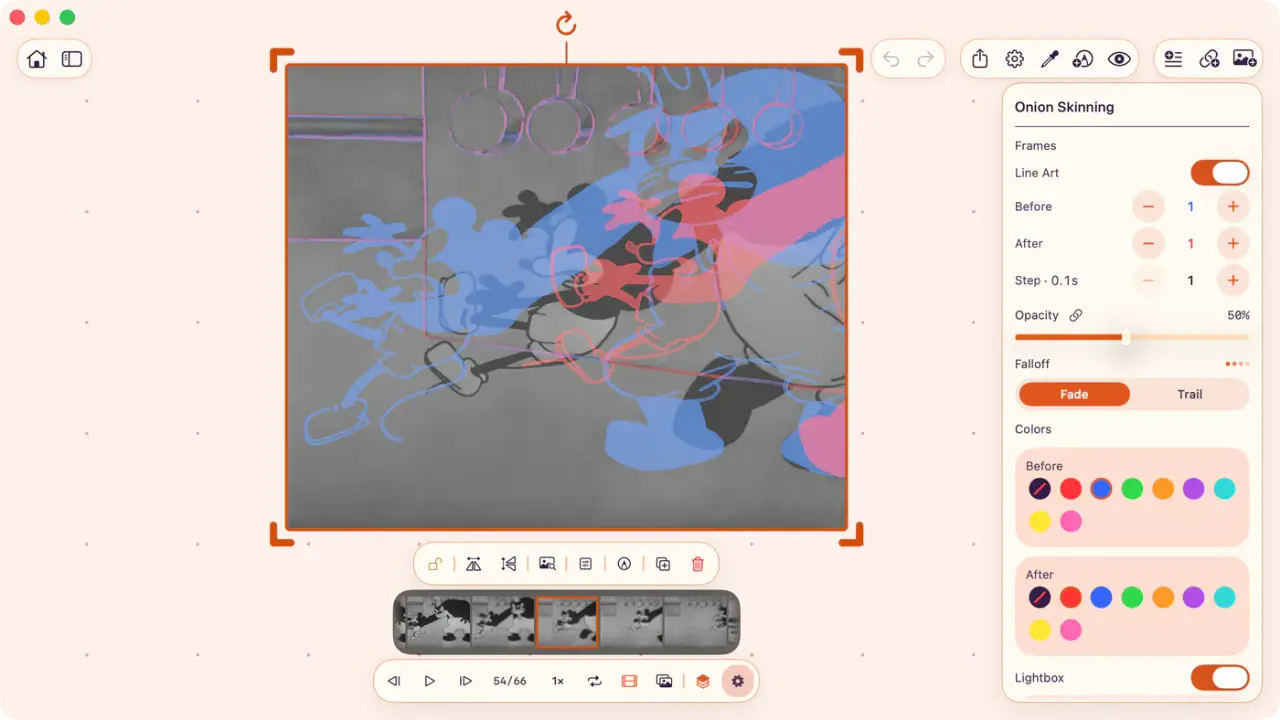
ArtDeck plays video on the board with speed control, frame stepping, and export of the frame you stopped on as a new image, and it adds onion skinning for video and GIFs and a filmstrip for GIFs. PureRef’s motion controls stop at animated GIFs, and it does not play video.
Onion skinning draws a chosen number of frames before and after the current one, samples them at an interval you set, colors the two sides separately, and can reduce them to line art, which is what makes the spacing between poses readable off footage. The motion study page shows the controls, and the frame-by-frame workflow walks through them on a real clip.
Still images are closer, and the extras fall on both sides. PureRef has per-image opacity, pixel coordinates, and a choice between nearest-neighbor and bilinear sampling. ArtDeck keeps the full image behind a crop, so framing can change later without importing the file again, and a color you pick lands on the clipboard ready for the app you are painting in.
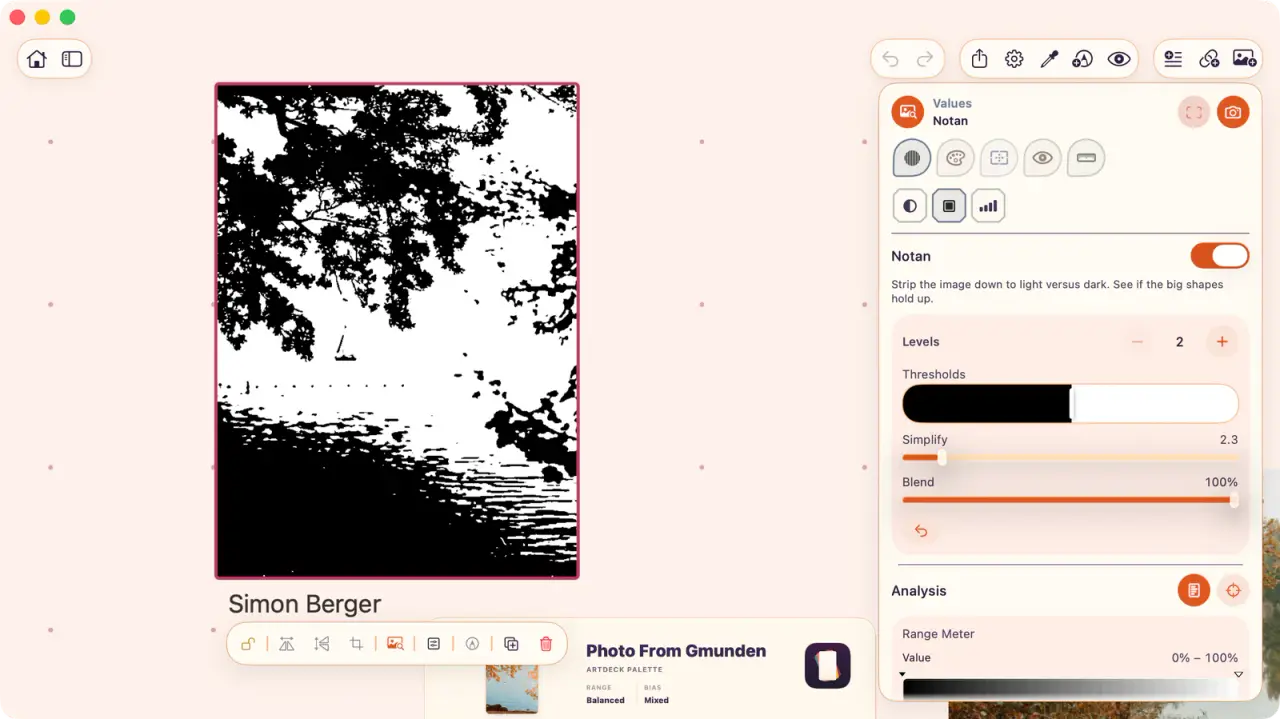
Reduce a photograph to two values and you learn in about a second whether its silhouette ever read. Pull the palette and you find out how little of that orange is actually in the frame. Measure the figure and a proportion you were about to guess at becomes a number.
Each check can be saved with its source, and opening a lens takes the same two taps whether you are practicing deliberately or just curious about why an image works. PureRef has no equivalent. The study tools page covers what each lens measures.
Commercial work changes the price
PureRef’s personal tier is pay what you want and covers hobby and educational use. Paid work needs the commercial license: $49 once for up to three people, then $8 per seat per month billed annually or $10 billed monthly. PureRef 1.x keeps its original license, which allowed commercial use.
ArtDeck is free for 7 days and then one App Store purchase, the same for personal and client work, with no seat count and no subscription to move onto as a studio grows.
Pick the app around your working setup
What each app is the right answer to
PureRef desktop reference canvas
- References live mainly on a Windows, Mac, or Linux desktop.
- Advanced always-on-top, click-through, or per-image overlay behavior is part of how you paint.
- A board of stills and GIFs is enough, without video reference or study lenses.
- You need rebindable shortcuts, or a macOS version older than 15.
ArtDeck board and study layer on Apple devices
- The board needs to work natively on iPad or iPhone as well as Mac.
- Optional per-board iCloud sync beats managing a scene file across devices.
- The reference moves, and reading timing and spacing off video matters as much as holding stills.
- You want to study what you collected, for deliberate practice or simple curiosity about why an image works.
- Video, PDFs, source links, palettes, histograms, and saved studies belong on the same board as the images.
Using both is reasonable: PureRef around a desktop painting or 3D app, and ArtDeck for the boards that travel across Apple devices. If you are undecided, start from where the board has to open.
Common questions
Is there PureRef for iPad or iPhone?
No. PureRef publishes builds for Windows, macOS, and Linux only. There is no PureRef iPad app, no PureRef iPhone app, and no PureRef iOS or mobile version of any kind, and remote desktop still needs a desktop running it.
Can ArtDeck open a .pur file?
No, and there is no importer. Export the images out of PureRef with File > Export > All images, then drop that folder onto an ArtDeck board. The pictures come across, and tidy, align, and distribute rebuild the arrangement in a few gestures.
Do I need a separate license for client work?
Not with ArtDeck. After the 7-day trial it is one App Store purchase with no commercial tier, no seat count, and no subscription. PureRef separates the two: personal use is pay what you want, and paid work needs a commercial license.
Does ArtDeck need an account or an internet connection?
Neither. Boards are local and work offline, and there is no ArtDeck account. Sync runs on your own iCloud, carrying every board across or leaving the ones you choose on a single device.
Is PureRef still the better choice for anything?
Yes. Its always-on-top, click-through, and per-image overlay modes are not in ArtDeck, it runs on Windows and Linux, and it supports older macOS versions. If you paint on a desktop and those modes are part of how you work, keep it. The two still sit side by side on a Mac, with ArtDeck holding the boards that travel and the studies taken from them.
For an image and GIF board on iPad, the VizRef comparison covers another option, and the reference app comparison covers free canvases, desktop libraries, and Windows and Linux tools.